
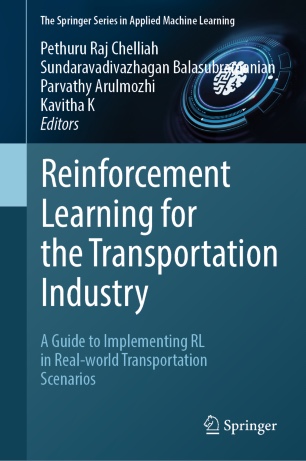
Reinforcement Learning for the Transportation Industry
A Guide to Implementing RL in Real-world Transportation Scenarios
From Q-learning and deep Q-networks to RLHF, RLAIF and LLM-guided reinforcement learning, this edited volume bridges RL theory with deployment in smart mobility, air mobility and sustainable transport.
About the book
Reinforcement learning is now a core method for sequential decision-making, and transportation is one of its most demanding fields: vehicles, signals, fleets and passengers all interact under uncertainty. This book starts from the technical foundations of RL, covering core architectures, formal frameworks and major algorithms such as Q-learning, policy gradient, actor-critic, deep Q-networks and multi-agent reinforcement learning. It then examines deep RL, reinforcement learning from human feedback (RLHF), reinforcement learning from AI feedback (RLAIF) and reinforcement fine-tuning, and their role in intelligent decision-making and large language models.
Later chapters turn to transportation applications backed by practical case studies, with special attention to AutoRL, federated reinforcement learning and LLM-guided deep RL for autonomous driving.
978-3-032-30248-9 (softcover)
978-3-032-30246-5 (eBook)
Formats, prices, release dates and availability are shown on the Springer page and may change. This page does not sell the book.
What you will find inside
RL foundations
- Core architectures and formal frameworks
- Q-learning, policy gradient and actor-critic
- Deep Q-networks (DQN)
- Multi-agent reinforcement learning (MARL)
Modern RL and LLMs
- Deep reinforcement learning (DRL)
- RLHF and RLAIF
- Reinforcement fine-tuning (RFT)
- AutoRL and federated RL
Road and urban mobility
- Autonomous vehicles
- Electric vehicle routing
- Traffic signal coordination and congestion reduction
- Ridesharing
Logistics, air and connected systems
- Transport logistics
- Advanced air mobility
- Intelligent transportation systems
- Internet of Vehicles (IoV)
Highlights, as listed by Springer
- Bridges RL theory with transportation-focused real-world deployment strategies
- Covers emerging RLHF, RLAIF and LLM-guided RL for next-generation AI systems
- Includes practical case studies on smart mobility, air mobility and sustainable transport
Who it is for
Researchers, academicians and industry professionals who want to implement advanced RL solutions for efficient, sustainable and intelligent transportation systems, as well as students looking for a route from RL basics to applied transportation work.
The editors
Pethuru Raj Chelliah
Principal AI architect at Infocion Inc., Bangalore. Earlier roles include vice president and chief architect at the AI division of Reliance Jio Platforms, and positions at IBM, Wipro and Robert Bosch Corporate Research.
Sundaravadivazhagan Balasubramanian
Faculty in Information Technology at the University of Technology and Applied Sciences, Al Mussanah, Oman. Research interests include IoT, AI and machine learning, deep learning, cloud computing and cyber security.
Parvathy Arulmozhi
Assistant professor at SASTRA Deemed to be University, Thanjavur, India. Areas of interest include embedded systems, IoT and machine learning.
Kavitha K
Assistant professor of computer science at Mother Teresa Women's University, Kodaikanal, India. Research interests include data mining, data analytics, cloud computing and IoT.
Editor details follow the book's Springer page.
Learn the foundations first
New to reinforcement learning? These pages on this site cover the basics and the algorithms the book builds on.
Questions
When is the book available?
Springer lists the eBook as due on 29 September 2026 and the hardcover as due on 24 February 2027. The eBook date has now passed, but I could not read Springer's page on 23 October 2026 to confirm that it has been published, so check the Springer page for the current status.
Which topics does it cover?
RL foundations, deep RL, multi-agent RL, RLHF, RLAIF and reinforcement fine-tuning, then transportation applications from autonomous driving and traffic signals to ridesharing, logistics and advanced air mobility.
Who are the editors?
Pethuru Raj Chelliah, Sundaravadivazhagan Balasubramanian, Parvathy Arulmozhi and Kavitha K.
Where can I order it?
On the Springer page linked above. Prices and formats are shown there.