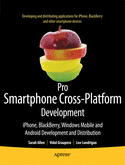

Pro Smartphone Cross-Platform Development
|
Book Authors:- Sarah Allen, Vidal Graupera and Lee Lundrigan Book Publisher:- Apress, USA Wireless communication is the most influential and inspiring discovery of the last century and this has grandly impacted the total humanity in dramatically absorbing ways. Today communication and computing happens in jungles, junctions, valleys, beaches, malls, motels, mountains etc. In a nutshell, anywhere anytime computing is the vision getting coolly fructified with the mass production and purchase of slim and sleek phones. The airwaves are being smartly and scientifically leveraged as the free communication carrier and conveyer infrastructure for any device and his owner to be in touch with any one across the continents, countries, counties and cities. Today mobile phones have emerged as the pervasive and persuasive interface for ubiquitous information access. The constant and compelling companion of people is nothing but the handy and trendy phone. Location restriction is a history now and at the same time, “location” is being envisaged as the futuristic and sustainable avenue for earning huge revenue for mobile service providers. In short, the wireless has come as a blessing for a variety of professional organizations such as wireless service providers, tower businesses, mobiles vendors, innovators, and enterprise application developers. The earlier cluttered environment due to endless and expensive wires makes a way for totally clutter-free environment. People can still talk and type messages while travelling at high speed and trekking at high altitude. The mobility paradigm has been opening up a series of fresh opportunities for researchers and big thinkers to conceive and construct scores of novel services, solutions and systems for providing enhanced care, choice, comfort and convenience to people. Further on, miniaturization and integration technologies are uninhibitedly flowering and flourishing these days in precipitating and championing a series of noteworthy shifts in our every day life. Mobile phones are steadily tending towards smart phones. Technically once mobile phones are termed as an embedded device. And today they are the next-generation and general-purpose computing devices. The new paradigm of mobile computing is getting accentuated and activated with the powerful emergence of smart phones. Smart phone applications and services are being designed diligently, developed optimally, registered and stocked in special service and application stores, which are increasingly found in cloud infrastructures these days, deployed in cloud-based containers and engines to be delivered over the web affordably. Considering the fast-growing business opportunity, there came a number of versatile mobile platforms, frameworks, middleware, tools and methodologies for creating and supplying multi-device, platform, channel, and faceted rich mobile applications (RMAs). Mobile operating systems, chipsets & processors and hypervisors are being produced in large quantities. With all the articulated advancements in the hot mobile space, smart phones are being considered favourably to realize robust and resilient mobile clusters, grids and clouds. A body of knowledge on mobile technologies, tips, trends and tools are being made available in order to prop up mobile application developers and deployers. In this book, the authors have painstakingly yet passionately presented the cross-platform development frameworks for engineering, simulating, emulating and porting a growing array of next-generation mobile services and applications in smart phones. The first part of this book covers the first five crucial chapters. The first chapter talks about the arrival of smart phones, their special qualities, and the need for cross-platform development frameworks. The second chapter gives a detailed explanation on developing mobile applications for iPhone using Xcode IDE. The third chapter does the same for the most popular and powerful Android smart phones. The leading general-purpose development tool “Eclipse” is being empowered to develop Android applications. The chapters 4 and 5 focus on developing captivating mobile applications in BlackBerry and Windows Mobile platforms. The second part is all about the cross-platform native frameworks. The chapter number 6 details about the Rhodes framework, how to build a Rhodes application, how to run it on an iPhone, Android, BlackBerry etc. The chapters 7, 8 and 9 target RhoSync, PhoneGap and Titanium Mobile frameworks for creating and porting native applications for a variety of smart phone platforms. The third and the final part of this book exclusively looks upon tips and techniques for using HTML to create look and feel web applications and services for the existing and emerging smart phones. Overall this book is a boon for mobile developers. The book is filled up with the source codes for many nice-to-have and instigating mobile applications. With smart phones being ticked as the new-generation PC, developmental practices, processes, patterns, products and platforms are coming out in full swing. The need of the hour is to prepare a group of energetic and elegant software engineers and user interface specialists for quickly and easily producing and porting lean, dynamic, adaptive, and on-demand smart applications for the extremely mobile world. The authors of this book have done really a considerable and comprehensive work towards that goal. This book is a must for every aspiring mobile professional to have a firm grip on the various individual as well as institutional developments happening in the mobile space. |