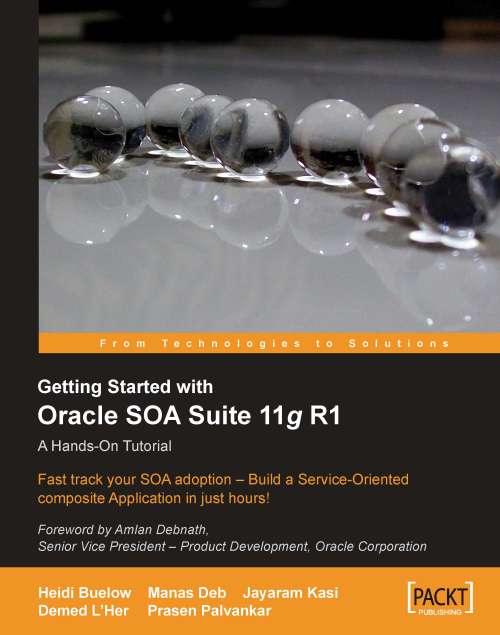

A Review on the hot-selling book
“Getting Started with Oracle SOA Suite
11g R1 – A Hands-On Tutorial”
|
In a nutshell, this book is a comprehensive yet compact tutorial about the Oracle SOA 11g module of the widely recognized Oracle Fusion Middleware (OFM) platform. The tutorial is presented in a free-flowing fashion. As indicated in the Oracle home page, OFM is a complete, integrated, open and best-of-breed platform. Oracle SOA 11g involves and invokes all the existing and emerging concepts such as service oriented architecture (SOA), business process management (BPM), service component architecture (SCA) and event-driven architecture (EDA) towards the realization and sustenance of aware and aligned composite services and applications. The total IT can be summed up in two key words: Decomposition and Composition. This robust and resilient middleware comprises all the versatile tools, predefined and prefabricated modules, containers, engines, wizards, and utilities in order to quickly and easily design, develop, debug, deploy and deliver of business-centric and novel applications. This book covers almost everything about this strategic and significant component of OFM in a detailed manner. The writing is very much inspiring, intuitive and informative. Illustrations, code samples, tips, guidelines etc are lavishly supplied in order to facilitate the learning through hands-on experience for even beginners. Authors have started the book with an elegant introduction about SOA and SCA. As futuristic IT systems are to be built using service orientation principles, the increasing workloads of developers and programmers are sharply getting decreased through the leverage and usage of this robust and resilient platform. The book plays a very constructive and prescriptive role in sharpening and shaping up the knowledgebase of engineers towards the impending service era. The authors have had first-hand experience in creating, delivering, and rolling-out SOA Suite 11gR1 training programs internally and externally to partners and customers. This book takes a divide-and-conquer approach and builds up a non-trivial service-oriented composite application in a step-by-step fashion so that it is easy for the reader to follow and appreciate the workings of the SOA Suite product. If your goal is to exploit SOA and related paradigms to deliver business value quickly, this book will put you on the right track. What this book covers The principal aim of this book is to get you operational with Oracle SOA Suite 11gR1 quickly and easily. In this spirit, the largest part of this book is dedicated towards a set of hands-on step-by-step tutorials that build a non-trivial SOA composite that you can deploy, test, run, monitor, and manage. Chapter 1 starts the book off with a quick refresher on some of the useful concepts regarding SOA and services and concludes with an introduction to Service Component Architecture (SCA). Chapter 2 discusses the key challenges in the technical implementation of SOA-based applications and how Oracle SOA Suite 11g leverages SCA principles to address these challenges. Chapter 3 describes the business and technical requirements for a purchase order (PO) processing composite and gives you an overview of how the complete solution will be built up in a set of discrete steps using a series of tutorials using Oracle SOA Suite 11gR1. Chapter 4 gives you the necessary instructions for download, installation, and configuration of Oracle SOA Suite 11gR1. The core functionalities of the PO processing composite that is described in Chapter 3 are built in Chapters 5 through 10. This series of chapters will teach you the basics of working with Oracle SOA Suite 11g and the IDE (JDeveloper). You start building the composite using a mediator, as well as web services and database adapters. You then add a file adapter and a BPEL (Business Process Execution Language) component to create a process that orchestrates the overall flow, adding human interaction, creating conditional process execution using business rules, and accessing external services via a JMS (Java Message Service) adapter. At the end of each and every chapter, you will have a composite that can be deployed, run, and tested. You are advised to go through these tutorial chapters, 5-10 in a sequential manner. The tutorials in Chapters 11 through 19 let you add more functionality to the composite and explore some of the operational features of Oracle SOA Suite 11gR1. You will learn service re-use and virtualization using Oracle Service Bus (OSB), explore some of the composite life cycle management features, test the composite using the unit testing framework, incorporate exception handling, add security policies to a service, set up a business activity-level tracking of the composite transactions using Oracle Business Activity Monitoring (BAM), work with events using the unified services and events platform of Oracle SOA Suite 11g, handle data using Service Data Object (SDO) specification, and connect the composite to a Business-to-Business (B2B) gateway using Oracle B2B. By the end of Chapter 19, you should have a good grasp of all components in Oracle SOA Suite 11gR1, and be able to create modular, full-featured service composites. The concluding remarks in Chapter 20 will briefly discuss some of the ways you could use such composites to provide business benefits. Who this book is for This book is intended for any SOA developer or architect, with some basic understanding of Service-Oriented Architectures and web services technologies. No prior knowledge of Oracle middleware is assumed. However, people with experience with SOA Suite 10g will find this material of interest as well because of its focus on how things work together, an area that has been greatly enhanced with the 11g release.
Pethuru Raj, PhD Home Page: www.boschresearch.com
|