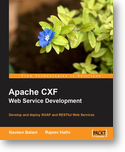

Apache CXF Web Service Development
|
It cannot be negated that software frameworks play a very vital role for the software engineering community. As frameworks put a kind of boundary and bring a set of constrictions, it is, to some extent, a dampener. However on the other side, frameworks halve the total work and facilitate bringing out a spectrum of robust and resilient applications. Programming complexities and workloads are gently and greatly minimized. Further on, the number of bugs would come down sharply due to the strict boundaries and a host of conditions implicitly imposed in any framework. In a nutshell, frameworks speed up the software engineering assignments by supplying most of the common modules that can be reused across domains for simplifying and streamlining the arduous process of application development and maintenance. All the constructive and contributory modules are implemented by experts, tested in different scenarios, refined religiously and intelligently incorporated within the framework and therefore its utility and usability are definitely supreme. Frameworks do a bit in moderating the software development complexity and the pioneering service orientation (SO) idea does a lot in minimizing the design complexity of ICT applications. With the powerful emergence of SO concepts, services have become the core building-block for designing, developing and deploying service oriented systems that are extensible and adaptive. Application architects and programmers are called to think and visualise enterprise systems in terms of self-described, autonomous, and interoperable services and their purpose-centric interactions. There are primarily two architectural styles for producing service-centric applications: SOAP and RESTful approaches. As usual, developers look for competent and standards-compliant frameworks for bringing down the workload of service engineering, inspection and configuration whereas managers are for cost-cutting. Worldwide professionals and providers collaboratively have come out with scores of open-source as well as commercial-grade frameworks. Academics too chip in with their innovative ideas in realizing versatile frameworks for the software engineering, which is lagging behind the hardware engineering. In this book, the authors have taken great pains in concisely and compactly explaining the relevance of Apache CXF framework for the fast-growing service field. The first chapter starts with a brief about the web services technology. They argue that among various web service frameworks, CXF stands tall due to its distinct capabilities, comprehensive set of highly reusable resources and enabling toolkits. Both SOAP and RESTful services can be constructed by leveraging this framework. There are several advanced features embedded in the framework that goes a long way in extensively helping out software engineers. The second chapter describes a sample application development (The order processing application) using web services and the CXF framework. They have talked about contract-first and code-first development approaches. The third chapter insists about the importance of CXF frontends, which help out in publishing and invoking web servers easily. The fourth chapter is a very interesting chapter explaining about all kinds of popular and pervasive transports such as http, JMS, and local transports. The first chapter revolves around the advanced features of Apache CXF framework and they are explained well with the sample codes, tips and techniques. The most expected chapter is 6th one as I have been looking for some practical information about RESTful services and how they can be built quickly. The chapter 7 digs deeper in order to throw some light on how RESTful services can be deployed using this prominent and dominant framework. The chapter 8 is all about the matured tools that come along with the framework in order to automate several manual tasks. There are some inspiring appendixes comprising valuable details for programmers. On concluding, this book is a must for both SOA-compliant service developers. The book comes out with a clear explanation what exactly the Apache CXF framework and how it can be handled smartly in order to rapidly come out with a wider variety of reliable services and ultimately robust applications. Authors, having acquired and accumulated a lot of knowledge in designing and implementing services using this framework, penned down an excellent book for beginners as well as experienced ones across the globe.
|